
Description
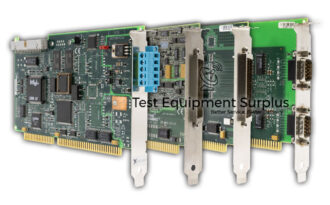
The part number 776093-01 identifies a specific GPIB component, known as the GPIB-1014DP. This component is a National Instruments GPIB-1014DP GPIB Interface for VMEbus, which is designed to fit as a Double Height Circuit Board within a system. The key functionality of this interface includes two independent and fully functional GPIB ports, allowing for versatile usage within a variety of setups.
The interface operates by connecting VMEbus to IEEE-488, enabling a transfer rate of up to 80 kbytes/s. It requires a 5 VDC power supply to function, with a current requirement of 1.1 A typical, but it can go up to 2.0 A maximum under certain conditions. The connectivity is facilitated through a Standard I/O 24 pin connector that adheres to the IEEE-488 standard, ensuring compatibility with a wide range of devices.
Moreover, the GPIB-1014DP offers flexible usage options, including being programmable as a Controller, Listener, or Talker. This level of versatility makes it an invaluable component for any setup requiring reliable and high-performance GPIB interface capabilities.
| Specification | Detail |
|---|---|
| Part Number | 776093-01 |
| Category | GPIB |
| Model | GPIB-1014DP |
| Description | National Instruments GPIB-1014DP GPIB Interface for VMEbus |
| Form Factor | Double Height Circuit Board |
| Functionality | Two independent and fully functional GPIB ports |
| Interface | VMEbus to IEEE-488 |
| Transfer Rate | 80 kbytes/s |
| Power Supply | 5 VDC |
| Current Requirement | 1.1 A typical, 2.0 A maximum |
| Connector | Standard I/O 24 pin connector of IEEE-488 standard |
| Usage Options | Controller, Listener, or Talker (programmable) |
Question 1: What is the part number for the GPIB-1014DP?
Answer 1: 776093-01
Question 2: What is the maximum transfer rate of the GPIB-1014DP?
Answer 2: 80 kbytes/s
Question 3: How many GPIB ports does the GPIB-1014DP have?
Answer 3: Two
Question 4: What is the maximum current requirement for the GPIB-1014DP?
Answer 4: 2.0 A
Question 5: Can the GPIB-1014DP function as a Controller, Listener, and Talker?
Answer 5: Yes