
Description
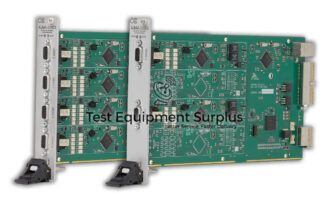
The product with the part number 778226-01 falls under the GPIB category and is known by the model name PXI-8212. This unit features both GPIB and Ethernet interfaces, making it versatile for various communication requirements. It is designed to be compatible with CompactPCI and PXI systems, ensuring a wide range of applications in different environments.
The PXI-8212 requires a 1-slot PXI module for installation, optimizing space within the system. At its core, it utilizes the NI TNT4882C ASIC for efficient data processing and handling. This ASIC supports IEEE 488.2 Functions such as Controller, Talker, and Listener, providing flexibility in its operation modes. Data transfer rates can reach up to 8 Mbytes/s, ensuring efficient communication and data handling.
Compliance with industry standards is critical, and the PXI-8212 adheres to IEEE 488.1, 488.2; PXI; CompactPCI; PICMG 2.0; and EEE 803.2u. It supports Ethernet Standards including 10BaseT and 100BaseTX, allowing for integration into existing network setups.
Regarding power requirements, the device operates with a maximum of 2A at +5 VDC and has a power consumption of 10 Watts. Connectivity is facilitated through a 24-bit IEEE 488 I/O connector and an RJ-45 Ethernet connector, ensuring a broad compatibility with peripheral devices.
The PXI-8212 is a 3U size module, weighing 140 g, and has dimensions of 16.0 x 10.0 cm. Its design allows for it to be software configurable, offering flexibility in use. Although its obsolete status has been announced, it remains available through Apex Waves, providing a reliable solution for specific system requirements.
Question 1: What is the transfer rate of the PXI-8212?
Answer 1: Up to 8 Mbytes/s
Question 2: What ASIC does the PXI-8212 use?
Answer 2: NI TNT4882C ASIC
Question 3: Is the PXI-8212 compatible with CompactPCI systems?
Answer 3: Yes, it’s compatible with CompactPCI and PXI systems.
Question 4: How much power does the PXI-8212 consume?
Answer 4: 10 Watts
Question 5: What connectors does the PXI-8212 have?
Answer 5: 24-bit IEEE 488 and RJ-45 Ethernet connectors