
Description
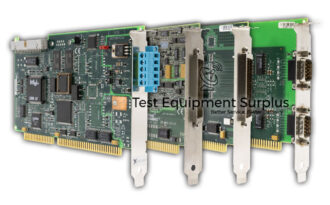
The National Instruments PXI-8462 PXI CAN Interface Module, part number 185316B-23, falls under the category of Automotive Networking Products. This product is a Double CAN Interface Module designed to provide efficient and reliable communication for automotive applications. It is fully compatible with both the PXI Specification and the CompactPCI Specifications, ensuring a wide range of application compatibility.
Model PXI-8462 features two distinct ports for communication. Port One is a high-speed port that adheres to the ISO 11898 standard, while Port Two is a low-speed port following the ISO 11519-2 standard. This dual-port configuration allows for versatile connection options to various systems and devices within automotive networks.
The module’s CAN Physical Layer Power can be sourced either internally, directly from the board, or externally, from the bus link power. This flexibility in power sourcing options is a significant advantage in various testing and development scenarios. Connection to external devices is facilitated through DB-9 D-Sub connectors, providing a reliable and standardized interface for data transmission.
An integral feature of the PXI-8462 is its use of the RTSI Bus for synchronization of functions across multiple boards. This capability is essential for complex systems requiring coordinated operations across several modules. At its core, the module is powered by an Intel 386EX embedded processor, which handles data processing and communication tasks efficiently.
Software interactions with the PXI-8462 are managed through the NI-CAN driver, which communicates with the module via on-board shared memory and an interrupt. This setup ensures seamless and efficient communication between the software and hardware components of the system.
For low-speed CAN operations, the module requires one resistor for each CAN line for proper termination. It also features robust fault detection capabilities, capable of identifying up to seven system faults, thereby enhancing system reliability. The module supports a node configuration range from 2 to 32 nodes for low-speed CAN, accommodating various network sizes and complexities.
Energy source control for the CAN Physical Layer is managed through jumpers J5 and J6, for port one and port two respectively, of the two-port sheets. This configuration allows for precise control over the power distribution for each port.
Despite being announced as obsolete by National Instruments, the PXI-8462 PXI CAN Interface Module remains available for purchase and repairs through Apex Waves, ensuring continued support
| Specification | Detail |
|---|---|
| Part Number | 185316B-23 |
| Category | Automotive Networking Products |
| Model | PXI-8462 |
| Description | National Instruments PXI-8462 PXI CAN Interface Module |
| Type | Double CAN Interface Module |
| Compatibility | PXI Specification and CompactPCI Specifications |
| Port One | High-speed port (ISO 11898) |
| Port Two | Low-speed port (ISO 11519-2) |
| CAN Physical Layer Power | Internally (from the board) or externally (from the bus link power) |
| Connector Type | DB-9 D-Sub connectors |
| RTSI Bus Usage | Yes, for synchronization of functions across multiple boards |
| Processor | Intel 386EX embedded processor |
| Software Interaction | NI-CAN driver through on-board shared memory and an interrupt |
| Low-Speed CAN Termination | Requires one resistor for each CAN line |
| Low-Speed CAN Fault Detection | Yes, can detect seven system faults |
| Low-Speed CAN Nodes | Supports 2 to 32 nodes configuration |
| Energy Source Control for CAN Physical Layer | Jumper J5 for one-port sheets/port one of two-port sheets; Jumper J6 for port two of the two-port sheets |
| Obsolete Status | Announced by National Instruments, available for purchase and repairs by Apex Waves |
Question 1: What is the part number of the PXI-8462?
Answer 1: 185316B-23
Question 2: How many CAN ports does the PXI-8462 have?
Answer 2: Two
Question 3: What processor powers the PXI-8462?
Answer 3: Intel 386EX
Question 4: Can the PXI-8462 power be sourced externally?
Answer 4: Yes
Question 5: Is the PXI-8462 compatible with PXI and CompactPCI?
Answer 5: Yes