
Description
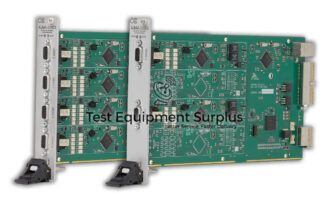
The product with the Part Number 780587-42 is categorized under PXI Switches. Specifically, it is the PXIe-2542 model, which is a National Instruments PXIe-2542 PXI RF Relay Module. This module is designed to operate at an Input Frequency of 10 Megahertz, and it features a Quad 2×1 Terminator Multiplexer configuration.
One of the key specifications of this product is its Characteristic Impedance, which is 50 Ohms with AC Coupling. It can handle a Maximum Safe DC Voltage Input of ±8 Volts. Regarding RF power, it supports up to +30 dBm when the chassis power is on, and up to +20 dBm when the chassis power is off. The Channel to Channel Skew is impressively less than 3 Picoseconds, and it has a Propagation Delay of 680 Picoseconds.
Its RF Signal Capability extends up to 6.6 GHz, ensuring wide applicability in various RF applications. The module boasts an Unlimited Mechanical Lifetime, highlighting its durability and reliability. Furthermore, it incorporates a FET as the Built-in Switch, enhancing its performance. Lastly, the Dimensions of this module are detailed as 21.6 L x 2.
| Specification | Details |
|---|---|
| Part Number | 780587-42 |
| Category | PXI Switches |
| Model | PXIe-2542 |
| Description | National Instruments PXIe-2542 PXI RF Relay Module |
| Input Frequency | 10 Megahertz |
| Configuration | Quad 2×1 Terminator Multiplexer |
| Characteristic Impedance | 50 Ohms with AC Coupling |
| Maximum Safe DC Voltage Input | ±8 Volts |
| Maximum RF Power (Chassis Power On) | +30 dBm |
| Maximum RF Power (Chassis Power Off) | +20 dBm |
| Channel to Channel Skew | Less than 3 Picoseconds |
| Propagation Delay | 680 Picoseconds |
| RF Signal Capability | Up to 6.6 GHz |
| Mechanical Lifetime | Unlimited |
| Built-in Switch | FET |
| Dimensions | 21.6 L x 2
Question 1: What is the maximum RF power of PXIe-2542 with power on? Question 2: What is the characteristic impedance of PXIe-2542? Question 3: What is the RF signal capability of the PXIe-2542? Question 4: What is the channel to channel skew of PXIe-2542? Question 5: What is the propagation delay of PXIe-2542? Related Products |