
Description
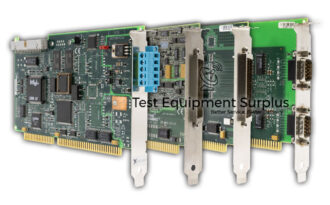
The product comes with part numbers 777387-01 and 182920-01, designed to cater to a wide range of applications with its impressive features. It boasts a 96 Channel, 24-bit configuration, making it highly capable in various data acquisition and control tasks.
The device’s characteristics include compatibility with TTL/CMOS, and it supports both bidirectional and unidirectional operations, along with a 2-wire handshake communication protocol. This flexibility ensures that the device can be integrated into a multitude of digital communication environments seamlessly.
For software interfacing, the device is compatible with NI-DAQmx drivers, ensuring easy integration with software applications for data acquisition and control. It also features four Programmable Peripheral Interface (PPI) chips, enhancing its programmability and versatility in handling complex tasks.
One of the standout additional features of this product is its compatibility with SCXI modules and accessories. This compatibility extends its functionality to include additional functions such as amplification, excitation, and isolation signal generation for relays, making it a highly versatile choice for a wide range of applications.
The device includes a Programmable Interval Timer (82C53), which allows for register-level programming and timed interrupt command generation, offering precise control over timing-sensitive operations.
It adheres to the PCI Local Bus Specification, Revision 2.1, ensuring compatibility with a wide range of PCI-equipped computers and devices. The product is designed with a known power-up state, with bias resistors controlling the digital I/O lines’ power-up state, enhancing the reliability and predictability of the device upon startup.
Software compatibility is extensive, including support for LabVIEW, LabVIEW Application Builder for Windows, LabWindows/CVI, and the LabVIEW Full Development System for Windows. This broad compatibility ensures that users can leverage the powerful features of this device across a wide range of software environments.
The device operates with a power consumption of 400 mA and is designed to function within an operating
| Specification | Detail |
|---|---|
| Part Numbers | 777387-01, 182920-01 |
| Channels | 96 Channel, 24-bit |
| Characteristics | TTL/CMOS, Bidirectional and Unidirectional, 2-wire handshake |
| Driver Compatibility | NI-DAQmx |
| PPI Chips | Four Programmable Peripheral Interface chips |
| Additional Features | Compatibility with SCXI modules and accessories for additional functions such as amplification, excitation, and isolation signal generation for relays |
| Programmable Interval Timer | 82C53 for register-level programming and timed interrupt command generation |
| PCI Specification | Compatible with PCI Local Bus Specification, Revision 2.1 |
| Power-Up State | Known power-up state with bias resistors controlling the digital I/O lines’ power-up state |
| Software Compatibility | LabVIEW, LabVIEW Application Builder for Windows, LabWindows/CVI, LabVIEW Full Development System for Windows |
| Power Consumption | 400 mA |
| Operating Temperature Range | 0 to 55 °C |
| Storage Temperature Range | –20 to 70 °C |
| Dimensions | 5.4 x 4.2 in |
| Weight | 3.6 oz. |
| Connector | 100-pin I/O connector |
| Obsolete Status | Announced by National Instruments but available for purchase and repairs at Apex Waves |
Question 1: What is the power consumption of PCI-DIO-96?
Answer 1: 400 mA
Question 2: How many channels does PCI-DIO-96 have?
Answer 2: 96 channels, 24-bit
Question 3: Is PCI-DIO-96 compatible with TTL/CMOS?
Answer 3: Yes, it’s TTL/CMOS compatible.
Question 4: What software supports PCI-DIO-96?
Answer 4: LabVIEW, LabWindows/CVI, LabVIEW Application Builder
Question 5: Does PCI-DIO-96 work with SCXI modules?
Answer 5: Yes, it’s compatible with SCXI modules.