
Description
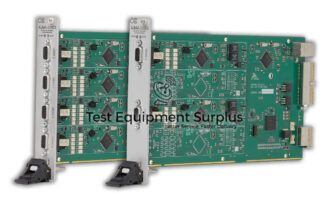
The Part Number 777429-01 represents a PXI Digital I/O module known as the PXI-6533. This module is designed to deliver high throughput for pattern I/O at up to 13.3 MB/s and for handshaked I/O at an impressive 77.8 MB/s. It comes equipped with 32 digital I/O lines, each capable of sinking or sourcing 24 mA.
With a maximum sample rate of 20 MHz, this device is engineered for rapid data transfer and processing. It supports various driver software including NI-DAQ, and is compatible with Application Development Environments (ADEs) such as LabVIEW, LabWindows/CVI, ComponentWorks, and VirtualBench.
The PXI-6533 features versatile triggering capabilities, including TTL/CMOS, Pattern, and Rising/Falling Edge triggers, catering to a wide range of applications. It operates at a voltage level of 5 V and can handle minimum pulse widths for edge triggers as low as 10 ns.
Connection to the device is facilitated through a 68-pin male SCSI-II I/O connector, ensuring a reliable and secure link to peripherals. Designed for durability and performance, the PXI-6533 can operate within a temperature range of 0 to 55 °C, making it suitable for various environments. Furthermore, its compact dimensions allow for easy integration into existing setups.
| Specification | Detail |
|---|---|
| Part Number | 777429-01 |
| Category | PXI Digital I/O |
| Model | PXI-6533 |
| Pattern I/O Throughput | Up to 13.3 MB/s |
| Handshaked I/O Throughput | 77.8 MB/s |
| Digital I/O Lines | 32 |
| Current per Line | Sink or Source 24 mA |
| Maximum Sample Rate | 20 MHz |
| Driver Software | NI-DAQ |
| Compatible ADEs | LabVIEW, LabWindows/CVI, ComponentWorks, VirtualBench |
| Triggering Capability | TTL/CMOS, Pattern, Rising/Falling Edge |
| Voltage Level | 5 V |
| Minimum Pulse Width for Edge Triggers | 10 ns |
| I/O Connector | 68-pin male SCSI-II |
| Operating Temperature | 0 to 55 °C |
| Dimensions | 6.4
Question 1: What is the throughput for handshaked I/O on the PXI-6533? Question 2: How many digital I/O lines does the PXI-6533 have? Question 3: What is the maximum sample rate of the PXI-6533? Question 4: What type of connector does the PXI-6533 use? Question 5: What is the operating temperature range for the PXI-6533? Related Products |