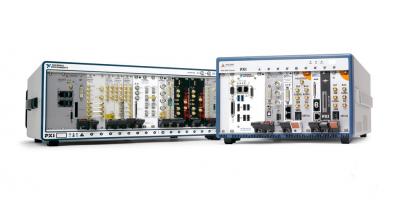

Description
“`html
The Part Number 780587-75 is associated with PXI Switches, specifically the model PXIe-2575. This model is described as NI PXIe-2575, Screened and falls under the category of a Multiplexer Switch Module. It supports various Topology Modes including 1-Wire, 196 channel and 2-Wire, 98 channel, which provides flexibility in connection setups.
The Relay Operation Time for this module is typically 1 ms, with a maximum of 3.4 ms, ensuring quick switching capabilities. It can handle a Channel to Channel Voltage of up to 100 Volts, with a Maximum Per Channel Switching Power of 60 Watts or 62.5 VA. The DC Isolation Resistance is rated at 1 Giga-ohms, offering excellent isolation.
For current handling, it has a Maximum Switching Current of 1 Ampere. The bandwidth capabilities vary with the topology mode; in 1-Wire mode, it exceeds 20 MHz, and in 2-Wire mode, it is over 8 MHz. The Differential Thermal EMF is typically 3 μV, with a maximum of less than 12 μV, indicating minimal thermal interference during operation. Lastly, this module boasts a Scanning Speed of up to Up to, facilitating rapid data acquisition and testing.
“`
| Specification | Detail |
|---|---|
| Part Number | 780587-75 |
| Category | PXI Switches |
| Model | PXIe-2575 |
| Description | NI PXIe-2575, Screened |
| Type | Multiplexer Switch Module |
| Topology Modes | 1-Wire, 196 channel; 2-Wire, 98 channel |
| Relay Operation Time | Typical: 1 ms, Max: 3.4 ms |
| Channel to Channel Voltage | Up to 100 Volts |
| Maximum Per Channel Switching Power | 60 Watts or 62.5 VA |
| DC Isolation Resistance | 1 Giga-ohms |
| Maximum Switching Current | 1 Ampere |
| Bandwidth (1-Wire mode) | > 20 MHz |
| Bandwidth (2-Wire mode) | > 8 MHz |
| Differential Thermal EMF | Typical: 3 μV, Max: < 12 μV |
| Scanning Speed | Up to
Question 1: What’s the model associated with Part Number 780587-75? Question 2: How many channels does the PXIe-2575 support in 1-Wire mode? Question 3: What is the max switching current for the PXIe-2575? Question 4: What’s the maximum Channel to Channel Voltage? Question 5: What is the typical Relay Operation Time? |